
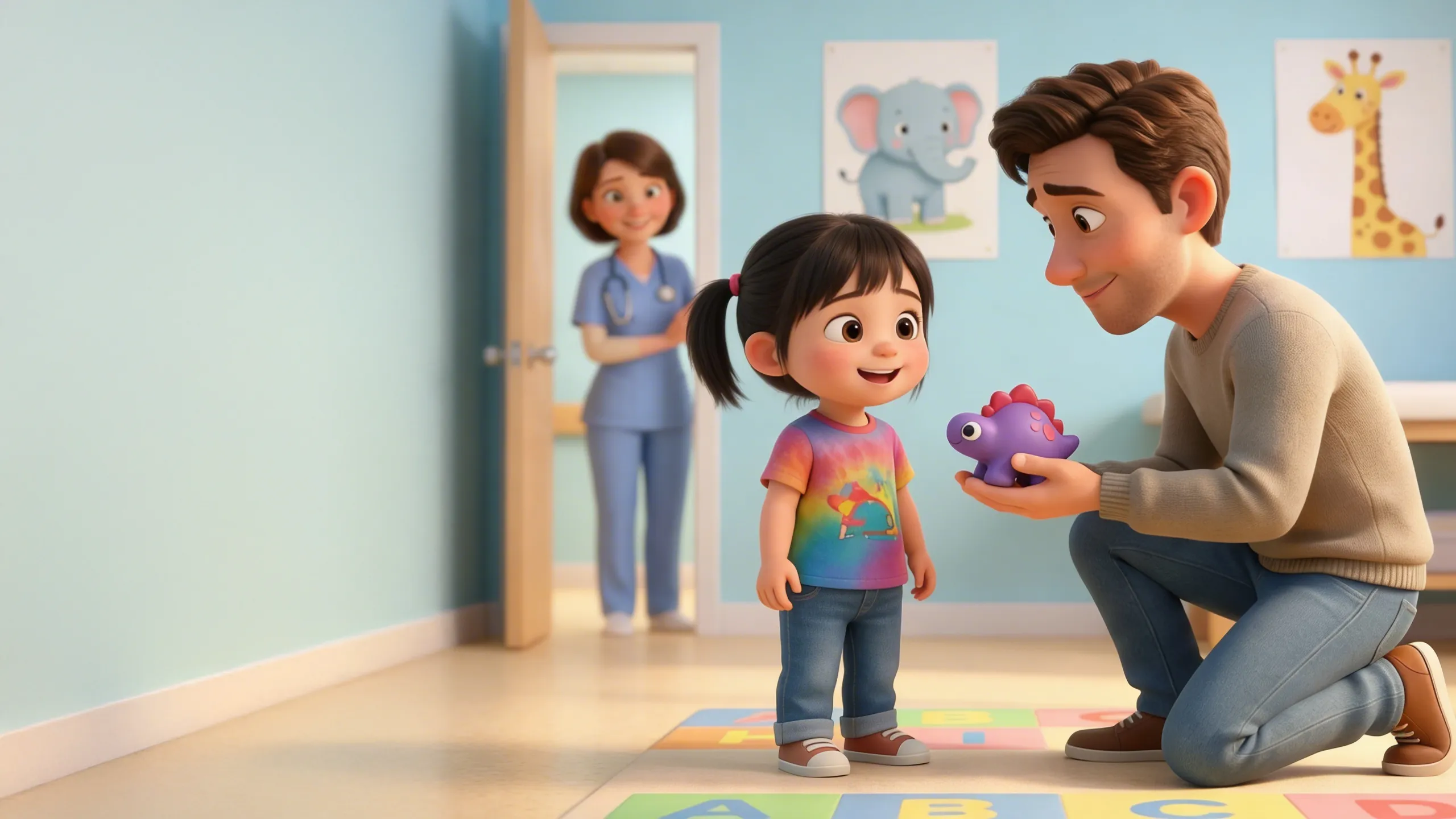
Nobody Gave You a Better Option. Until Now.
You’ve held them down long enough. There’s a better way.
Shot day doesn’t have to mean tears, bargaining, and a child who dreads the doctor. MedBuddy® was built for this exact moment — and for every parent who ever wished there was something more they could do.
You already know what shot day feels like.
You booked the appointment weeks ago and immediately started dreading it. You thought about what you’d say in the car on the way there. You promised yourself this time would be different — calmer, easier, less of a whole thing.
And then you watched their face in the waiting room when they figured out why you were really there.
You’ve tried everything. The ice cream promise. The counting to three. The “it’ll only take a second” that both of you knew was technically true but somehow made nothing better. You’ve held them still when they fought.
You’ve wiped their tears. You’ve felt guilty on the way home even though you did exactly the right thing by bringing them.
Here’s what nobody has ever told you: you were never failing. You were fighting a biological fear response with
nothing but love and creativity. Nobody gave you a better option.
Until now.
“You’ve promised ice cream. You’ve counted to three. You’ve held them tight and told them to be brave. You’ve felt guilty on the drive home. Every parent who has ever taken a child for a shot knows this feeling. You are not alone — and it is not your fault.”
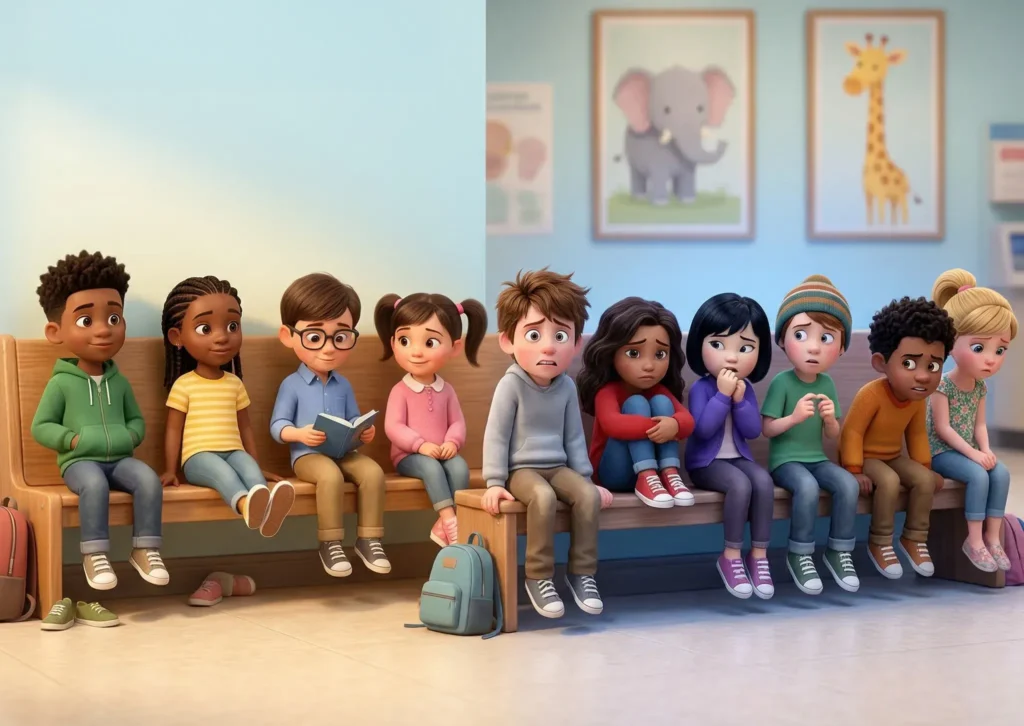
Needle fear affects up to 63% of children. That means in a waiting room of ten kids, six of them are already dreading what’s coming. This is not a parenting problem. It is not a sensitivity problem. It is a design problem — and it is one that has gone unsolved for 182years.
Since the syringe was invented in 1844, the experience of receiving an injection has been essentially unchanged. The same device. The same visual. The same fear. No one redesigned the experience for the person receiving it. No one invented something that actually comforted the child.
Your child’s fear is not unusual. It is not something they need to “get over.” It is a completely normal response to a situation that was never designed with their emotional experience in mind.
MedBuddy® was.
63%
of children report significant fear before vaccination appointments
182
years since the syringe was invented — without a solution to needle fear
25%
of adults still carry clinically significant needle phobia from childhood experiences
That last number matters. The fear your child feels today doesn’t automatically disappear when they grow up. Research shows that early negative injection experiences contribute to lasting medical anxiety — including avoidance of doctors, delayed vaccinations, and resistance to medical care that follows children into adulthood.
What happens in that exam room today shapes how your child relates to healthcare for the rest of their life. That’s not meant to alarm you. It’s meant to explain why MedBuddy® was invented in the first place — and why it matters so much more than just one easier afternoon.
“After witnessing a child uncontrollably crying while receiving a shot, Chase — a FedEx driver who delivered to hospitals on his route — was motivated to find a way to make the situation less traumatic for the child. From there the invention evolved and MedBuddy® was born.”
— The MedBuddy® Origin Story
Why shot day fear is more than just a bad afternoon
Most parents think of injection fear as an unavoidable part of childhood — something to endure, manage, and move past. And in the absence of a better option, that’s reasonable. But when you understand what’s actually happening in your child’s brain, and what the research says about where that fear goes over time, the picture looks different.
REASON 01
Early fear becomes lifelong avoidance
Children who experience traumatic injection encounters are significantly more likely to avoid medical care as adults. They skip flu shots. They delay blood tests. In some cases, they avoid doctors entirely. The emotional template set in childhood — the association between medical care and fear and pain — is remarkably durable. A positive injection experience, by contrast, sets a different template. One where the doctor’s office is associated with comfort, reward, and positive memories.
REASON 02
Fear affects the whole family — not just the child
When a child dreads an appointment, the stress doesn’t stay contained, it radiates. Parents feel anxious in advance. Siblings observe and absorb. The emotional weight of shot day accumulates visit by visit, and the dread gets worse before it gets better — unless something changes. MedBuddy® changes it.
REASON 03
It quietly undermines vaccine compliance
Families who dread injection appointments are more likely to delay booster doses, miss follow-up visits, and put off vaccinations that their children need. Fear-driven avoidance is one of the least discussed — and most real — barriers to keeping children protected. Every time shot day goes badly, the next one becomes harder to schedule.
REASON 04
Your child deserves to feel safe at the doctor
This one is simple. Healthcare should be a place children feel cared for. A child who leaves a vaccination appointment clutching a toy they chose, proud of themselves and already thinking about next time, has had a fundamentally different experience of what medical care means. That experience is worth building. And it compounds. MedBuddy® is providing child comfort in healthcare.
How MedBuddy® Works – Three moments. One completely different experience.
MedBuddy® is a patented series of playful figurines that attach to a syringe barrel using a proprietary safety clip. It was designed around a single insight: the most powerful way to reduce a child’s fear during an injection is to give them something to look forward to before it, something to focus on during it, and something to celebrate after it.
The process takes less than twenty seconds. The impact lasts far longer.
STEP 1
Your child picks their buddy
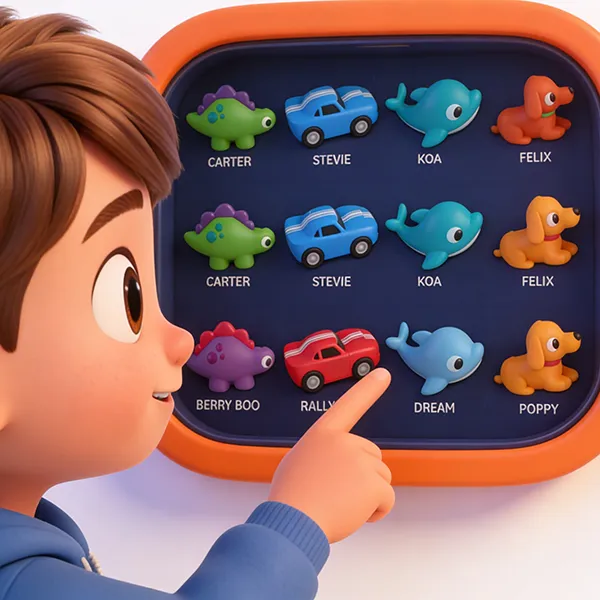
Before the injection, your child is shown a selection of MedBuddy® figurines and invited to choose one. This is the moment everything shifts. They’re no longer thinking about the needle — they’re thinking about the dinosaur. The dog. The race car. The dolphin. They have something to look forward to. They have a choice. They have control in a situation that usually offers them none. Research confirms that the anticipation of a chosen reward releases dopamine before the reward even arrives. The fear baseline drops before the syringe is anywhere near them.
STEP 2
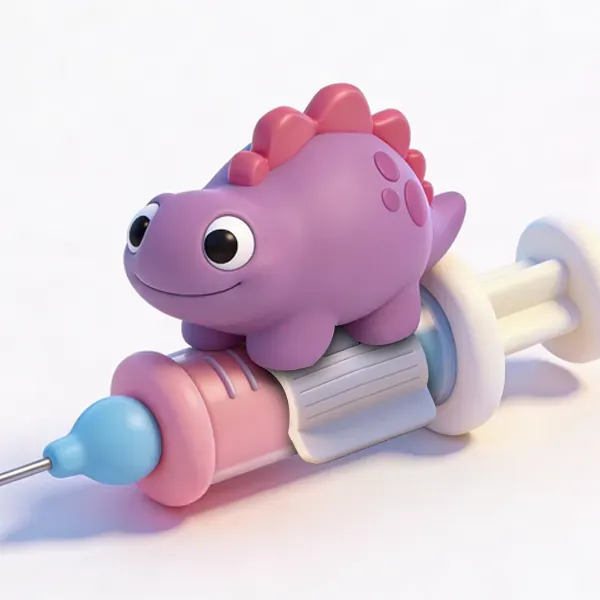
MedBuddy® rides on the syringe
The chosen figurine clips securely to the syringe barrel using MedBuddy®’s proprietary safety clip. The syringe is now disguised. The primary visual fear trigger — the syringe itself — has been replaced by something a child actively wants to look at. Your child’s eyes are on their buddy. Not on the needle. Not on the nurse’s hands. Not on the thing they’ve been dreading. The brain cannot fully process fear and focused visual attention simultaneously. The distraction is not just a comfort measure — it is a neurological intervention. Multiple nurses in independent research noted that the clip also provides a more secure grip on the syringe — an unexpected clinical benefit that makes the procedure safer and smoother for everyone.
STEP 3
MedBuddy® goes home with them
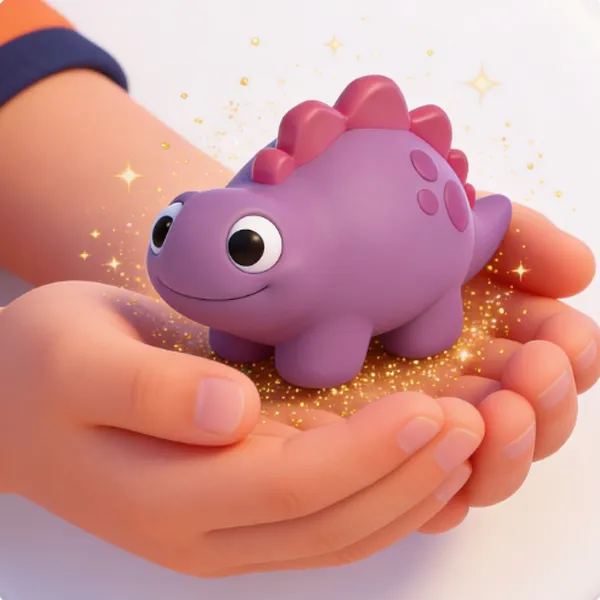
The moment the injection is complete, the figurine is unclipped from the safety clip and placed in your child’s hands. It’s theirs. They earned it. They chose it. It’s going home with them. This is the moment the emotional memory of the appointment is formed. Research on memory and emotion confirms that experiences are remembered largely by how they end. A child who leaves an appointment holding a toy they love, proud of themselves, already imagining their next adventure — that child has a different memory of the appointment than the one you’ve been dreading. And next time? They remember the buddy, not the needle.
What makes it different from a sticker or a lollipop:
MedBuddy® isn’t a consolation prize handed over after a traumatic experience. It is woven into every moment of the appointment — the anticipation before, the distraction during, and the reward after. The figurine is chosen by the child, visible throughout the procedure, and taken home as a keepsake. It is a behavioral intervention, not a bandage.
What shot day looks like with MedBuddy®
This is the part we most want you to imagine. Not just an easier appointment — but what your child’s relationship with medical care looks like when it’s built on positive experiences instead of fear.
For your child

Shot day becomes something they actually look forward to
They get to choose which buddy they’ll pick before you’ve even mentioned the appointment
The crying, fighting and bargaining stops — replaced by genuine excitement
They build a collection of buddies that tells the story of every brave moment they’ve experienced
They start to see the doctor as a place where good things happen
The fear that was building visit by visit begins to unwind
For you
You stop dreading the appointment reminder on your phone
The guilt trip on the way home disappears entirely
You get to be the parent who found the solution — not the one holding them down
The conversation in the car changes from dread to anticipation
You watch your child walk out of the clinic holding their buddy and feel genuinely proud
You tell every parent you know about the thing that finally worked
For the long term
Your child builds a positive emotional template for medical care that stays with them
Booster doses, annual checkups and future appointments become genuinely manageable
The 25% of children who develop lifelong needle phobia — your child doesn’t become one of them
Healthcare remains something your child engages with rather than avoids

It’s not just incredibly cute. It’s backed by science.
We know you’ve tried things that promised to help and didn’t. You deserve to understand why MedBuddy® is different — and the answer is that it’s not a distraction technique someone invented on intuition. It is the deliberate application of decades of peer-reviewed behavioral science to a problem that has never been taken seriously enough to solve.
The neuroscience of distraction
Gate Control Theory — established in peer-reviewed neuroscience since 1965 — confirms that pain signals from the body don’t travel unfiltered to the brain. When the nervous system is receiving competing signals — visual, cognitive, emotional — a gate in the spinal cord can partially or fully close to pain signals. A brain that is genuinely occupied with something else processes pain less intensely. This is not placebo. It is measurable, reproducible, and well-established.
Why choice makes distraction more effective
Research consistently shows that distraction is significantly more effective when the child chose the distraction themselves. When children select their own comfort object before a procedure, they report lower pain scores and demonstrate less behavioral distress than children given a random object. The act of choosing also restores a sense of agency — reducing the baseline fear response before the distraction even begins.
The reward anticipation effect
When the brain anticipates a specific, chosen reward, it releases dopamine before the reward arrives. This neurochemical shift begins the moment the reward becomes anticipated — not when it is received. In practical terms: a child who has chosen their figurine before the injection begins is neurochemically different from a child who hasn’t. The fear baseline is lower. The cooperation is higher. The experience is better.
What independent research confirmed
MedBuddy® was tested over four weeks by STREAM Research, an independent national research firm, through structured interviews with nurses, physician assistants, and pharmacists. The study confirmed that MedBuddy® can be safely used during injection procedures without interfering with technique or clinical outcomes. Response from medical professionals was unanimously positive. Multiple practitioners noted they would actively recommend MedBuddy® to their patients.
What a nurse said:
“I love that they get to select the toy attachment — that’s a big deal. It gives them that autonomy and gives them the sense of control. I like the idea. I think it will initially ease the anxiousness.”
— Angie, Registered Emergency Department Nurse, STREAM Research Study
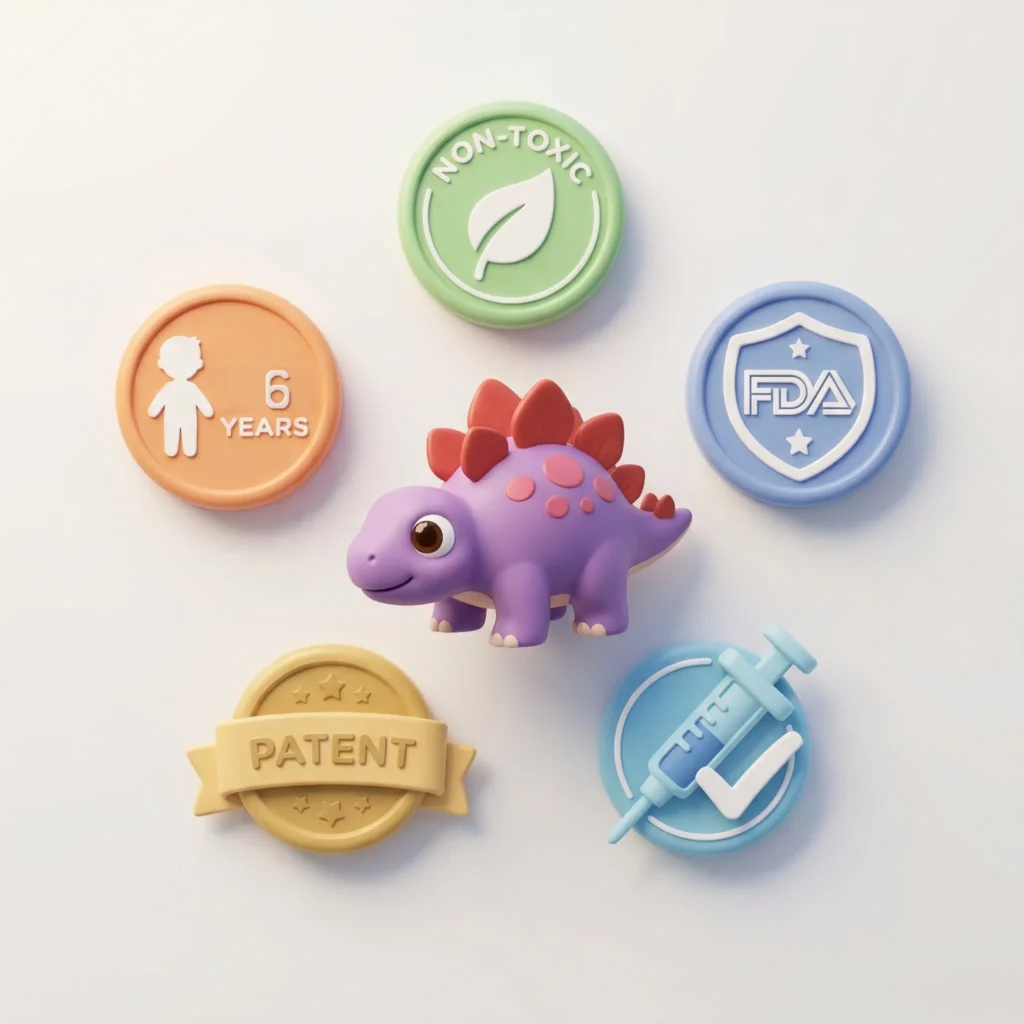
1 – Non-toxic and non-hazardous
Every MedBuddy® figurine is made from non-toxic, non-hazardous materials. There are no sharp parts. No small components that detach in ways that pose a risk. It is designed to be held by a child immediately after a medical procedure. The clip is a choking hazard and must be discarded immediately.
2 – FDA Class 1 exempt
MedBuddy® is classified as a Class 1 exempt device by the FDA — meaning it meets safety requirements as a medical device accessory without requiring additional regulatory approval. In plain terms: it has been evaluated, it is safe, and it is ready for clinical use.
3 – Doesn’t interfere with the injection
MedBuddy® attaches to the syringe barrel — not the plunger, the needle, or any component involved in the injection mechanism. Independent research confirmed it does not interfere with technique, dosing, or clinical procedure in any way.
4 – U.S. patented
MedBuddy® holds U.S. Patent 10,427,060 B2 covering the device, the clip, and the method of use. It is the only product of its kind.
5 – Designed for ages 1 to 16
The figurine system was specifically developed for children in the age range most affected by injection fear — with age-appropriate characters and sizes that feel right in little hands.
HOW TO GET MEDBUDDY®
Be the Hero
You don’t have to wait for the next appointment to feel like the last one. Here are three ways to bring MedBuddy® into your child’s next visit.
Frequently asked questions
Every question a parent asks before trusting MedBuddy® with their child